
Reviewed · KUMASI TOURS
One day tour at Kumasi
Kumasi’s most memorable stories are tied to objects: a royal war amulet, a sword said to be immovable, a strip of Kente cloth, and Adinkra symbols pressed into fabric by hand. This private tour brings those objects together, from Asante royal museums to working craft villages.
I like the excellent range, especially the way the day links court life, military history, traditional design, and everyday commerce. I also like the private format, which gives your group room to ask questions, spend longer at a favorite stop, or request an adjustment. The main drawback is pace: seven stops in roughly 4 to 8 hours can feel full, and lunch is not included.
Key points at a glance
- A royal and military story: Manhyia Palace Museum, Kumasi Fort, and Prempeh II Museum show different sides of Asante power.
- The immovable sword: Okomfo Anokye Sword Site offers a brief but memorable look at one of Kumasi’s best-known sacred landmarks.
- Hands-on craft stops: At Ntonso and Adanwomase, you see how Adinkra and Kente are made, not just finished in a shop.
- Private touring: Your group travels alone, with an air-conditioned vehicle and the option for a more flexible day.
- A useful market finish: Kejetia Market is the right place for local goods, souvenirs, and a final dose of city energy.
- Strong personal service: The tour team includes guides and drivers such as Jones, Josephine, Godfrey, and Kofi, with a record of adapting plans to individual interests.
Why Kumasi works best through objects and places
Kumasi is the historic center of the Asante Kingdom, and this tour gives you a practical introduction without asking you to piece the story together on your own. Each stop adds a different layer: royal ceremony, war, religion, cloth production, and trade.
That range matters. A museum alone can leave you with dates and names. A craft village alone can feel like a shopping stop. Put the two together, and you begin to see how power, belief, design, and commerce connect in Asante culture.
The tour begins at Manhyia Palace Museum at 8:00 am and ends at Kejetia New Market and Bus Terminal. Pickup is offered, and the private arrangement means only your group takes part. The vehicle is air-conditioned, a useful comfort in Kumasi, especially on a full day with several stops.
The listed price is $130 per person. That is not a budget city outing, but the value improves if you are sharing the vehicle with family or friends and want a private guide rather than a fixed group schedule. Museum fees and taxes are included. You will need to budget separately for lunch and anything you buy at the craft villages or market.
A few more Ghana days to weigh up
- One Day Tour To Cape Coast, Elmina Castle, Kakum National Park
★ 5.0 · 21 reviews - From Accra: Cape Coast and Elmina Castles Day Trip
★ 5.0 · 19 reviews - 1 Day cocoa farm tour
★ 4.5 · 11 reviews
Manhyia Palace Museum and the Asante royal court
Start with 45 minutes at Manhyia Palace Museum. The museum is not large, so do not arrive expecting a sprawling palace complex. Its strength is the concentration of historic objects connected with the Asante Kingdom, including war amulets and other items tied to royal life.
The palace opened in 1995 during the Silver Jubilee celebration of the accession of the Golden Stool. That detail gives the visit modern context as well as historical weight. The Golden Stool is central to Asante identity, and the museum helps explain why royal objects carry meaning far beyond their material value.
I would pay close attention to the war amulets and ceremonial pieces rather than rushing toward the most obvious display. They help show how warfare, spiritual protection, and kingship were linked. Your guide can also help turn unfamiliar names and symbols into a story you can follow.
Forty-five minutes is enough for a focused introduction, but it is not much time for a slow museum visit. If royal history is your main interest, tell the guide at the start. The private format should make it easier to give this first stop the attention it deserves.
Kumasi Fort and the Ghana Armed Forces Museum
The next stop lasts about an hour at Kumasi Fort, home to the Ghana Armed Forces Museum. This is where the tour shifts from royal tradition to conflict and colonial-era military history.
The collection includes military equipment and objects linked to the British Asante war of 1990, as well as the Second World War. It also contains weapons, colors, medals, armored cars, portraits, and photographs. Together, these items trace changes in Ghana’s military story from the colonial period to the present.
The date given for the British Asante war may require clarification from your guide, since the wording is not very precise. That is one reason a guided visit is useful here. Instead of treating every label as a complete explanation, you can ask how the objects relate to the Asante resistance, British rule, and Ghana’s later development.
The fort itself adds atmosphere to the visit. This is not simply a room full of uniforms and equipment. The setting helps you think about how military power operated in Kumasi and how the country’s institutions changed over time.
An hour is a reasonable amount of time. Military enthusiasts could easily want longer, while other people may find the displays dense. If you prefer people and daily life to weapons, balance this stop with extra attention at the craft villages later in the day.
Prempeh II Museum and a smaller royal collection
Prempeh II Museum takes about 25 minutes, making it the shortest museum stop. It is small, but the personal nature of the collection makes the visit worthwhile.
The displays include King Prempeh II’s war attire, ceremonial clothing, jewelry, protective amulets, bathing and dining equipment, furniture, royal insignia, and brass weights once used to weigh gold. These are the details that make a ruler feel like a person rather than a name in a textbook.
The building was designed to resemble an Asante chief’s house. A courtyard sits in front, while carved traditional symbols decorate the walls. That design gives you a better sense of how objects might have been arranged in a royal or chiefly setting.
Admission includes a personalized tour. Use it well. With only 25 minutes, you will not have time to examine everything at length, so ask about the items that catch your eye. The brass gold weights are particularly useful for understanding the connection between trade, craftsmanship, and political power.
This stop is best treated as a short, focused portrait of royal life. It is not a substitute for Manhyia Palace Museum, but the two visits complement one another.
Same departure point, a completely different day out:
- The Cape Coast Day Tour
★ 5.0 · 525 reviews - Experience the Beauty, History and the Culture Of Accra in a Day
★ 5.0 · 323 reviews - The Cape Coast Tour
★ 5.0 · 177 reviews - From Accra: Cape Coast, Elmina Castle & Kakum Park Day Tour
★ 4.6 · 144 reviews
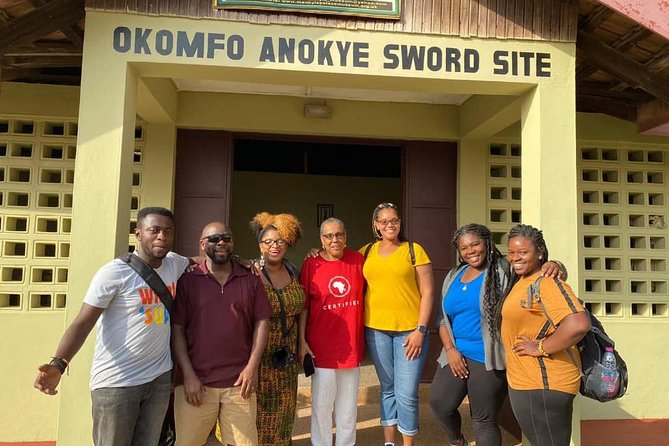
Okomfo Anokye’s immovable sword
The visit to Okomfo Anokye Sword Site lasts about 15 minutes. That may sound brief, and it is, but the site has an unusual pull.
The sword is said to have been driven into the ground by Okomfo Anokye and then become immovable. It sits inside a small museum built around the location. The story belongs to Asante tradition and connects the physical site with spiritual authority and the founding of the kingdom.
You should keep your expectations realistic. This is a compact stop, not a long museum visit with a large collection. Its value comes from seeing the object in its own setting and hearing the story attached to it.
Because the stop is short, it works well between the larger museums and the craft villages. Take a moment to notice how different kinds of authority appear across the day: the palace represents kingship, the fort represents military force, and the sword represents spiritual power.
Ntonso, where Adinkra begins with the cloth itself
At Ntonso Adinkra Cloth Village, you have about 50 minutes to see traditional Adinkra production. Ntonso is described as the homeland of Adinkra cloth and the only place in Ghana where the cloth is made locally from scratch.
That phrase matters. You are not simply browsing printed souvenirs. You may see the process behind a cloth known for its symbols and proverbial wisdom, including the stage where designs are applied by hand.
The symbols are the heart of Adinkra. They communicate ideas and sayings, so a piece of cloth can carry a message as well as a pattern. Ask the guide or craft worker to explain the meaning of the designs you see. This is where the stop moves beyond shopping and becomes a lesson in visual language.
You may also have the chance to try Adinkra symbol printing. That hands-on element is one of the strongest parts of the day because it lets you understand the craft through your own effort. It also gives you a more meaningful souvenir than a quick purchase from a market stall.
Fifty minutes is enough for a demonstration and some browsing, though it may feel short if you want to compare many cloths or make several purchases. Prices are not included in the tour, so carry a separate spending budget and remember that buying is optional.
Adanwomase and the meaning woven into Kente
The journey continues to Adanwomase, where traditional Kente cloth is still made. The visit lasts about an hour, and it is one of the most useful stops for understanding how design and social meaning work together.
Kente has long been worn by African kings. Its appeal is not only the bright pattern, but also the meaning behind the weave. There are more than 300 patterns, each with a name and an idea linked to proverbs, historic events, important chiefs, or valuable plants.
You might find the weaving process more interesting than the finished cloth. Look at the narrow strips and repeated patterns, then consider how separate pieces become a larger ceremonial fabric. The work requires patience and precision, and the symbolism gives every design a place within a wider cultural system.
This is another place where buying can tempt you. Take time to ask what a pattern means before choosing anything. A smaller piece with a known symbol may be more satisfying than a larger item selected only for color.
The tour description lists admission here as free. Purchases remain your responsibility. An hour gives you enough room for a demonstration, questions, and shopping without turning the stop into a rushed photo break.
Kejetia Market, the city’s noisy finale
The final stop is Kejetia Market, also called Kumasi Central Market. You spend about an hour here, ending at Kejetia New Market and Bus Terminal.
After the quiet focus of the museums and villages, Kejetia changes the mood. It is an open-air market in Kumasi’s Ashanti region, and it gives you a look at the everyday commercial side of the city. This is where you can shop for locally made goods and souvenirs, compare items, and watch the flow of city life.
An hour is enough for a first look, but the market can feel like a lot after six earlier stops. Keep your shopping goal simple. If you want fabric, craft items, or gifts, ask the guide to help you locate suitable areas rather than wandering without a plan.
The end point is practical if you are continuing by bus or want to remain in central Kumasi. It also means the tour does not return you to the starting point by default, so confirm your onward plans before the day begins. Pickup is offered at the start, but the listed end is Kejetia.
Private transport, timing, and the tour’s pace
The private format is the clearest advantage for people with specific interests. You can ask for more explanation at a museum, move faster through a display that does not hold your attention, or discuss an extra cultural stop if the schedule allows.
One past booking included a request to visit the Akwasidae festival, and the company was able to add it. That does not guarantee the same change for every date, but it shows why you should raise special interests before departure rather than assume the schedule is fixed.
The total duration is listed as roughly 4 to 8 hours. The wide range reflects traffic, time spent shopping, discussion with the guide, and any changes to the plan. Seven stops can fit into a shorter day if visits are brisk, but a slower day with questions and craft demonstrations will likely approach the longer end.
Guides and staff named in past bookings include Jones, Josephine, Godfrey, and Kofi. Jones is associated with a flexible driving and guiding style, while Josephine has handled visits shaped around research interests. Kofi is described as involved in planning and personal service. You cannot assume one particular person will lead your booking, so ask when confirming if a named guide matters to you.
The air-conditioned vehicle is included, along with fees and taxes. Lunch is not. Since the day finishes at a market, you may find food there, but the supplied details do not promise a meal arrangement. Plan to ask the operator about lunch timing before setting out.
Who gets the best value from this Kumasi tour
I would choose this experience if you want a broad first look at Kumasi and prefer having the cultural links explained as you go. It suits first-time visitors, families, private groups, and anyone who wants both museums and working craft traditions in one day.
It is also a good fit for people interested in textiles. Ntonso and Adanwomase are not filler stops. They show two different design systems, one based on stamped symbols and the other on woven patterns with names and meanings.
History fans will appreciate the three museums and the sword site, though the short visit at Prempeh II Museum and the 15-minute sword stop may feel too quick for specialists. If your main aim is detailed military or royal research, ask whether the schedule can be adjusted.
The tour is less suitable if you want a slow day with long meals, extended shopping, or time to sit in one place. Its strength is range, not relaxation. You cover a lot of ground, and the reward is a connected picture of Kumasi rather than a single long museum visit.
The booking has a five-star average from six ratings, with particular praise for the team’s flexibility, care, communication, and personal attention. That is a small sample, so I would treat it as encouraging rather than conclusive. Still, the repeated focus on helpful staff and custom requests fits the private-tour design.
Should you book this Kumasi experience?
Book it if you want the major Asante cultural stops arranged into one private day, with transport, admission fees, and room for personal questions included. The mix of royal objects, military displays, sacred tradition, Adinkra, Kente, and market life gives you much more than a basic city drive.
At $130 per person, the price makes the most sense for a small group sharing the vehicle and for anyone who values an adjustable schedule. You should be comfortable with a busy itinerary, separate lunch costs, and the possibility that shopping time competes with museum time.
I would confirm your preferred pickup point, likely pace, lunch plan, and guide assignment before departure. You can cancel for a full refund up to 24 hours before the local start time. Poor weather may lead to a new date or a full refund. With those details settled, this is a strong choice for a focused first day in Kumasi.
FAQ
Where does the tour start and end?
The scheduled start is Manhyia Palace Museum in Kumasi at 8:00 am. The tour ends at Kejetia New Market and Bus Terminal.
How long does the Kumasi tour last?
The experience takes approximately 4 to 8 hours. The final timing can vary depending on traffic, time at each stop, shopping, and any adjustments to the private schedule.
Is hotel pickup available?
Pickup is offered. The supplied meeting information lists Manhyia Palace Museum as the start, so confirm your exact pickup arrangement when booking.
Is lunch included?
No. Lunch is not included in the price.
Are entrance fees included?
Admission fees are included for Manhyia Palace Museum, Kumasi Fort and the Ghana Armed Forces Museum, Prempeh II Museum, and Okomfo Anokye Sword Site. Admission at Adanwomase is free. Kejetia Market admission is not included.
Can I cancel the tour for a full refund?
Yes. You must cancel at least 24 hours before the experience start time for a full refund. Cancellations or changes made within 24 hours are not accepted for a refund. If poor weather causes the tour to be canceled, you will be offered another date or a full refund.
Just added around Ghana
- Accra: Tafi Kente Village, Monkey Sanctuary &Wli Waterfalls★ 4.5 · 4 reviews
- 2 Days (1 night) Elephants Safari at Mole Park with Round – trip flights★ 5.0 · 4 reviews
- Full-Day Wli water Falls and Monkey Sanctuary Private Tour★ 5.0 · 4 reviews
- 4 Days Safari to Mole park and Wechiau Hippos★ 5.0 · 19 reviews
- 3 Days Zaina Luxury Experience Mole Safari★ 5.0 · 5 reviews
- Hike Mount Afadjato and Visit Wli Falls and Monkey Sanctuary★ 4.8 · 5 reviews
- Discover Cape Coast and Elmina Castle with Kakum★ 5.0 · 5 reviews
- 9 Day Ghana Wildlife and Culture Tour★ 5.0 · 5 reviews
Kumasi Tours, compared.

Bonwire Namimg Ceremony and Kente Tourist Center
Read our review →
Traditional naming ceremony For African Diasporas in Kumasi
Read our review →
Lake Bosomtwe Boat Cruisely and Kumasi City Tours
Read our review →Browse the lists this tour appears in