
Reviewed · CAPE COAST & ELMINA CASTLE TOURS
Accra and Cape Coast Escape
Ghana’s past comes into sharp focus at Elmina Castle and Cape Coast Castle, where Portuguese, Swedish, Danish, and British trading powers built forts that later became major sites in the Atlantic slave trade. The experience is serious and often painful, but it gives you essential context for Ghana and the wider African diaspora.
I like the way this tour joins two very different sides of the country: Kakum National Park’s rainforest canopy on the first day and Accra’s independence landmarks on the second. I also like the practical price, since transportation, entrance fees, fuel, taxes, and hotel pickup within Accra are covered. The main drawback is the long first day. The drive to Kakum can take about four hours, and visiting both castles in one day may feel heavy.
Key points to know before booking
- Two full days from Accra: Day one heads west to Kakum, Elmina, and Cape Coast. Day two stays in Accra.
- The castles are the emotional center: Both sites address Ghana’s role in the Atlantic slave trade, and the subject matter can be difficult.
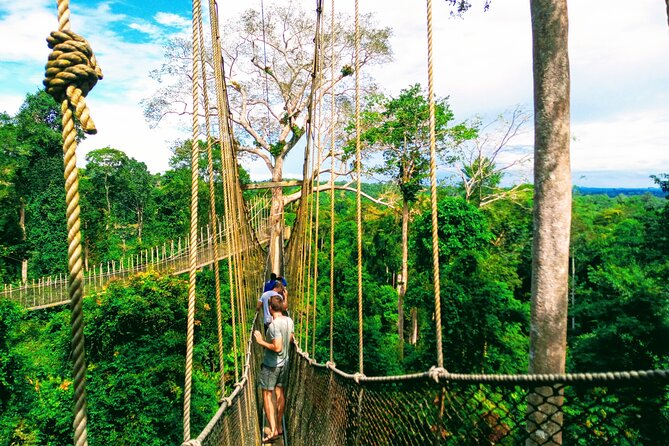
- Kakum’s canopy walkway is the outdoor highlight: You’ll walk about 30 meters above the forest floor.
- Guides can shape the experience: Zainab received special praise for her warmth and clear help during the long day.
- $250 covers the main touring costs: Meals, accommodation, and sightseeing not named in the program are extra.
- A group of up to 40 is possible: Ask about the expected group size if you prefer a quieter outing.
Why these two days give you a useful first look at Ghana
This is not a gentle introduction built around beaches and easy photo stops. It is a compact look at Ghana’s ecology, colonial past, independence story, Pan-African thought, and traditional arts.
That mix is the tour’s greatest strength. In two days, you see rainforest plants and birds, European fortifications, memorials to Ghana’s first president, a major site of national ceremony, and a market filled with Kente cloth, carvings, jewelry, and clothing.
The program is also efficient for someone based in Accra. You do not need to arrange separate transport to the Central Region or negotiate entry at each major site. The cost is $250 per person, with group discounts offered. That is a fair package if you value a guide, local transport, and included admissions more than free time or a custom schedule.
The tradeoff is pace. Day one covers a great deal of ground. Day two is less taxing, but its short stops mean you will get an introduction to each place rather than a long visit. I would choose this experience for a first Ghana trip, especially if you have limited time and want the main cultural landmarks in one booking.
Other visits to the Cape Coast and Elmina castles:
- The Cape Coast Day Tour
★ 5.0 · 525 reviews - The Cape Coast Tour
★ 5.0 · 177 reviews - From Accra: Cape Coast, Elmina Castle & Kakum Park Day Tour
★ 4.6 · 144 reviews
Kakum National Park and its 30-meter canopy walkway
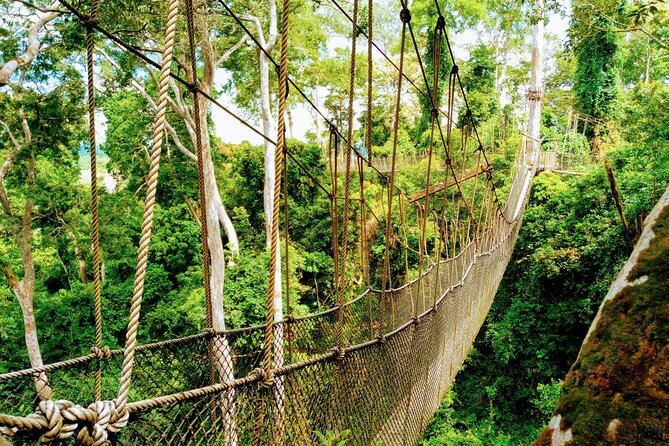
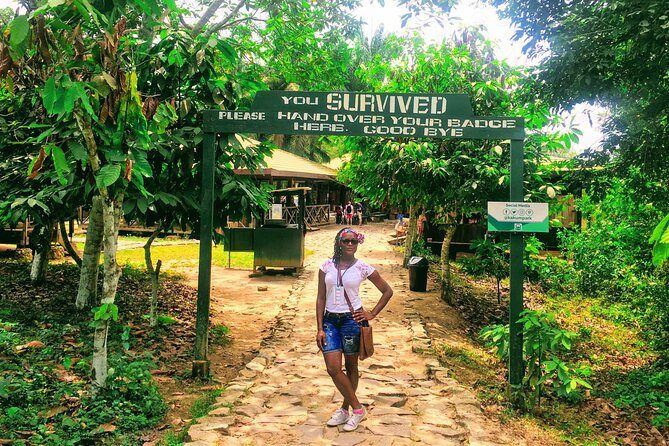
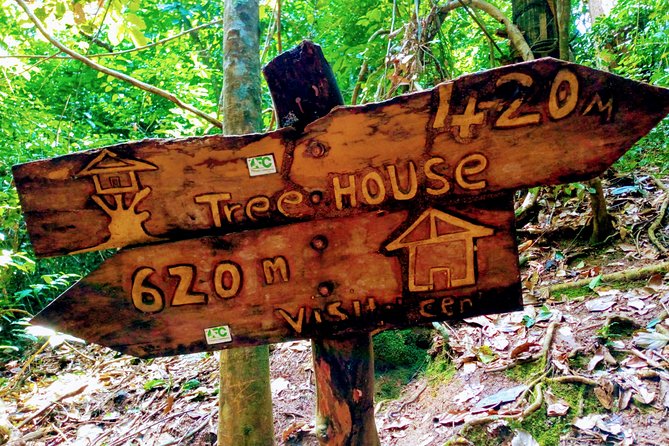
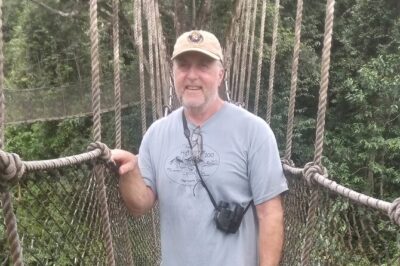
Kakum is the first stop on the long journey west from Accra. Established in 1932, the park protects mostly undisturbed tropical rainforest, with trails through dense vegetation and a canopy walkway suspended roughly 30 meters above the ground.
The walkway is the obvious draw. From the treetops, you get a different view of the forest, with leafy growth stretching around and below you. It is not simply a lookout platform. You walk across suspended sections above the ground, which gives the visit a mild adventure element without turning it into a full-day outdoor expedition.
Kakum is also a good reminder that Ghana’s story is not limited to forts and politics. The park protects habitat for many species, including forest elephants, bongo antelope, and several types of monkeys. More than 200 bird species are represented, including hornbills, kingfishers, bee-eaters, parrots, and blue plantain-eaters.
You may not see the larger animals during a short visit. The value is the forest itself, the birdlife you might spot, and the chance to walk above the canopy. The planned stop lasts about two hours, and admission is included.
Pack patience for the road. The drive to Kakum has been described as about four hours, so the first day depends heavily on traffic and road conditions. If you dislike long vehicle journeys, this is the part to consider carefully. If you enjoy nature and want more than an urban tour, Kakum earns its place.
Elmina Castle and the weight of the Atlantic slave trade
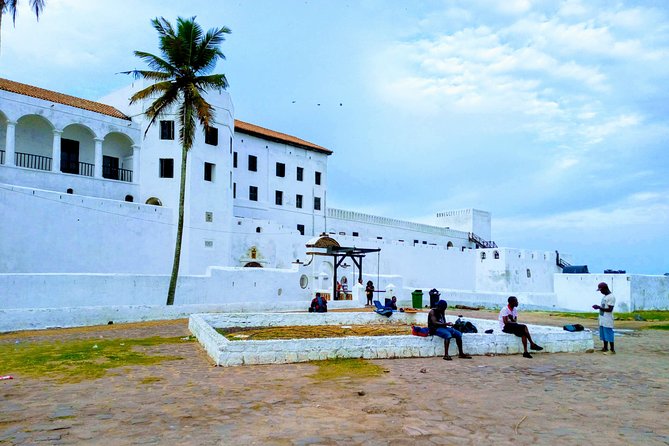
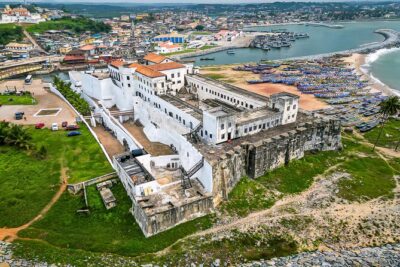
Elmina Castle dates to 1482, when the Portuguese established São Jorge da Mina. It was the first European trading post on the Gulf of Guinea and is described as the oldest surviving European building south of the Sahara.
The fort began as a trading center connected to gold and other goods. Its role later changed, and Elmina became one of the key places tied to the Atlantic slave trade. A visit here is not just a walk through old stone rooms. It forces you to consider how trade, colonial power, and human suffering became tied together in one place.
The scheduled visit lasts about an hour. That is enough for a guided introduction, though you may wish you had more time to pause and absorb what you are seeing. The subject can be difficult, and the review material makes clear that some people found the castle visits emotionally overwhelming.
I would not treat Elmina as a quick photo stop. Listen closely, ask questions when appropriate, and allow yourself quiet time afterward. The site matters because it connects Ghana’s local history to a much larger story involving Africa, Europe, the Caribbean, and the Americas.
Cape Coast Castle and a second difficult lesson
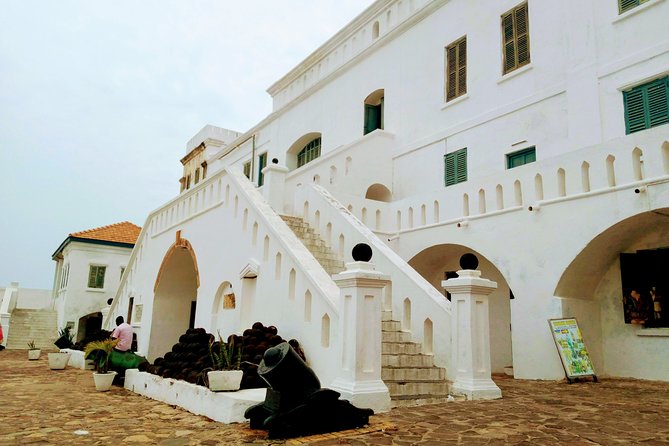
Cape Coast Castle adds another layer to the day. The first trading lodge here was built by the Portuguese in 1555. Swedish, Danish, and other foreign powers later controlled or rebuilt the fort, reflecting the competition for timber, gold, and influence along the Gold Coast.
Like Elmina, Cape Coast Castle became an important site in the Atlantic slave trade. Seeing both forts in one day helps you compare them, but it also means the historical material comes one after another with little time to reset.
The visit is planned for about an hour, with admission included. The castle’s size and long chain of foreign control help explain how European powers maintained commercial and political footholds on the coast. The story is not presented as a single-country episode. It is about a system that involved many powers and caused lasting harm.
Some people will find the two castle visits essential. Others may find them too much for one day. I would especially recommend the paired visit if you want a serious understanding of Ghana’s connection to the diaspora. If you prefer a slower pace, ask before booking if the schedule can be adjusted, since changes to the program have caused frustration when communication was unclear.
A few more Accra days to weigh up
- Experience the Beauty, History and the Culture Of Accra in a Day
★ 5.0 · 323 reviews - Accra Detailed City Tour
★ 4.5 · 118 reviews - Accra Guided City Tour Experience
★ 4.7 · 88 reviews - Accra Guided City Tour Experience
★ 5.0 · 76 reviews
Accra begins with W.E.B. Du Bois
Day two turns from coastal forts to modern Pan-African history at the W.E.B. Du Bois Center. Du Bois was an African-American civil rights activist who became a citizen of Ghana in the 1960s and is often called the Father of Pan-Africanism.
The center occupies the place where he lived with his wife. They are buried there, and the grounds include a mausoleum, personal library, museum displays, seminar room, restaurant, gallery, amphitheater, and research center.
You have about 40 minutes here. That is a short visit, but the site is compact and focused. Personal items, including his graduation robes, help make the story more immediate than a general political lecture.
I like this stop because it links Ghana to Black political thought beyond the country’s borders. It also gives day two a strong opening. After the difficult castle visits, you move into questions of African identity, independence, civil rights, and Pan-African cooperation.
Kwame Nkrumah Memorial Park and Ghana’s independence story
The Kwame Nkrumah Memorial Park honors Ghana’s first president, Osagyefo Dr. Kwame Nkrumah. The mausoleum is his final resting place, and the museum presents personal effects, publications, photographs, and scenes from his political life.
The stop lasts about an hour, which gives you more time than at the Du Bois Center. Nkrumah is central to Ghana’s independence from British colonial rule, and this memorial helps explain why his name remains important in the country’s public life.
Look for the personal side of the display. The museum is not only about speeches and government. Its objects and photographs show the people and events connected to Nkrumah’s career.
The memorial works best when you place it beside the next stop, Independence Square. One explains the person and political movement. The other shows how national identity is expressed through public ceremony and symbols.
Independence Square and the Black Star symbols
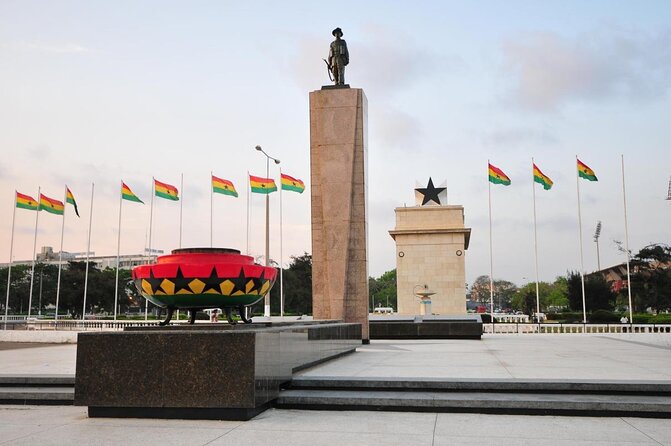
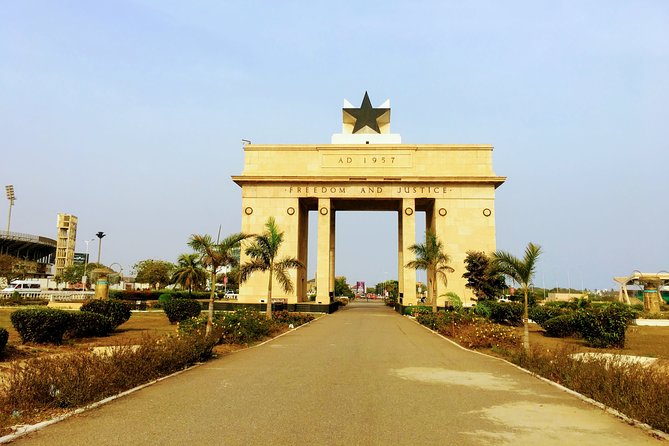
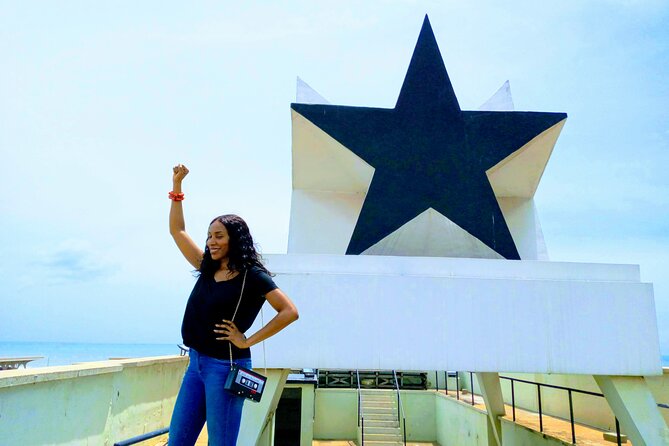
Independence Square, also called Black Star Square, is a vast concrete space with spectator stands that can hold about 30,000 people. The square includes the Independence Arch, the Flame of African Liberation, and the Black Star Gate, also called the Black Star Monument.
The scheduled visit is only 20 minutes. That is enough to see the main structures, hear why they matter, and take photographs, but not enough for a long historical discussion.
The setting can feel stark because the square is so broad and open. That is part of its purpose. This is a civic space built for national ceremonies, not a cozy neighborhood monument. Kwame Nkrumah commissioned it in connection with the visit of Queen Elizabeth II, and its symbolism later influenced other African countries seeking independence.
I would keep expectations realistic. You are not visiting a museum with many objects to examine. You are seeing a large public statement in stone, concrete, and metal. The short stop works well in a tightly planned city tour.
Shopping at the Center for National Culture
The final stop is the Center for National Culture, often called the Arts Center. It is a practical place to shop for Ghanaian crafts, including woven Kente cloth, wooden sculptures, earrings, fashion accessories, and African clothing.
You have about 30 minutes here. That is enough to browse, but not enough to inspect every stall at a leisurely pace. If shopping is important to you, this may be the one stop where you want extra time.
The market also gives the tour a lighter finish after several serious historical sites. You can see how Ghanaian artistic traditions are presented for daily use, gifts, and clothing. Ask your guide for help if you need to compare items or understand what you are buying.
Remember that the cost of purchases is not included in the tour price. Bring room in your luggage and set a spending limit before you arrive. The market is best treated as an opportunity, not an obligation.
What $250 includes, and what it does not
At $250 per person, this experience bundles the costly parts of a two-day outing: local transportation, fuel charges, taxes, guide support, hotel pickup and drop-off within Accra, entrance fees, and listed activities.
That makes the price easier to judge than a simple admission-only tour. You are paying for the long drive to the coast, transport between several sites, and the time required to cover both Accra and the Central Region.
Meals are not included. Accommodation is also not included, so you need to arrange your own lodging in Accra. Sightseeing outside the stated stops will cost extra, as will purchases at the Arts Center.
Group discounts may improve the value for families or parties booking together. The maximum group size is 40, which is fairly large. A large group can make transport practical, but it may mean less flexibility at the castles and market. The meeting point is Accra Mall at the Tetteh Quarshie Interchange, though pickup within Accra is offered.
Confirmation is provided at booking. Most people can participate, service animals are allowed, and the meeting area is near public transportation. The activity requires good weather. If poor weather cancels it, you should be offered another date or a full refund. You can cancel for a full refund up to 24 hours before the start time.
Who will get the most from this Ghana tour
I would choose this tour if you want a broad first look at Ghana and have only two days available. It suits history-focused visitors, people tracing African diaspora connections, first-time visitors staying in Accra, and anyone who wants a guide for the complicated castle sites.
It also works for solo visitors. Guide Zainab received particular praise for being kind, informative, and reassuring during a one-day trip to Kakum, Elmina, and Cape Coast. The company has also provided female guides, which may matter to solo women who want added comfort while exploring outside Accra.
I would think twice if you want a relaxed schedule, long meals, or plenty of free time. The four-hour drive to Kakum can make day one tiring, and the two castles cover emotionally demanding material in quick succession.
Should you book the Accra and Cape Coast Escape?
Book it if your priority is seeing Ghana’s key historical and cultural sites without arranging transport, admissions, and guiding on your own. The combination of Kakum, the two castles, Du Bois, Nkrumah, Independence Square, and the Arts Center gives you a strong range of experiences for two days.
Skip it, or ask about a private version, if a group of up to 40 sounds too large or if you want more time at each site. Also plan for meals and accommodation separately, and treat the first day as a long road day rather than a leisurely outing.
For most first visits to Accra, I see this as a useful, serious introduction. It will not show you every side of Ghana, but it puts the country’s environment, political past, and cultural identity in the same frame.
FAQ
How long is the Accra and Cape Coast Escape?
The experience lasts approximately two days, with one full day for Kakum National Park, Elmina Castle, and Cape Coast Castle, followed by a full day of sightseeing in Accra.
What is included in the $250 price?
The price includes local transportation, entrance fees, hotel pickup and drop-off within Accra, fuel charges, taxes, guide support, and the activities listed for the two days.
Are meals included?
No. Daily meals are not included, so you should budget for food separately.
Is accommodation included?
No. Accommodation is not included in the tour price.
Where does the tour start?
The stated meeting point is Accra Mall, Plot C11, Tetteh Quarshie Interchange, Spintex Road, Accra. Pickup within Accra is also offered.
How many people can join the tour?
The activity can have a maximum of 40 travelers.
Are entrance fees included?
Yes. Admission to Kakum National Park, Elmina Castle, Cape Coast Castle, the W.E.B. Du Bois Center, Kwame Nkrumah Memorial Park, Independence Square, and the Center for National Culture is included.
Can I cancel for a refund?
Yes. You can cancel at least 24 hours before the experience start time for a full refund. Cancellations or changes made less than 24 hours before the start time are not accepted for a refund.
Just added around Accra
- Experience Aburi Botanical Gardens And Boti Water Falls In A Day.★ 5.0 · 3 reviews
- Experience Cape Coast Castle and Kakum National Park★ 4.5 · 3 reviews
- Accra city tour★ 4.5 · 3 reviews
- 7days/6nights Eco Tourism★ 5.0 · 3 reviews
- Half-Day City Tour of Accra★ 5.0 · 3 reviews
- 3 Days Accra City Tour & Cape Coast Tour★ 4.5 · 3 reviews
- Local Ghanaian Food Tasting Tours★ 5.0 · 3 reviews
- Accra Zoo, Canopy Walk and Botanical Gardens Private Tour★ 5.0 · 3 reviews
Cape Coast & Elmina Castle Tours, compared.

Cape Coast, Elmina Castle & Kakum Park Day Tour
Read our review →

10 Days Trip to Cape Coast and Elmina Castles from Accra
Read our review →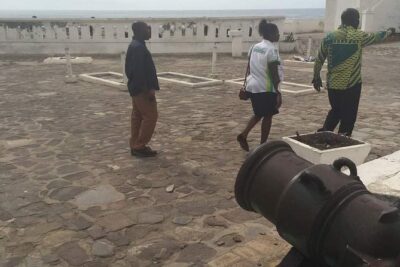
The Homecoming Experience To Cape-coast And Elmina.
Read our review →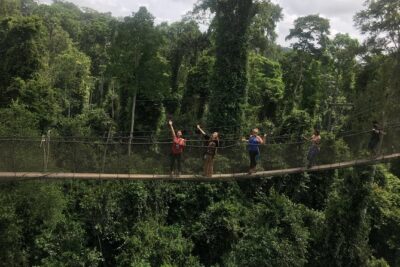
Cape Coast/Elmina Slave Dungeon and Canopy Walkway Private Tour
Read our review →
Assin Manso Slaves River and Cape Coast Castle Tour
Read our review →Browse the lists this tour appears in