
Reviewed · ACCRA TOURS
Ghana 8 Day Special
Ghana’s story comes into sharp focus on this eight-day route, from Accra’s Pan-African landmarks to the Ashanti royal court in Kumasi and the sobering castles of Cape Coast and Elmina. You also get hands-on cultural stops, including Kente weaving in Bonwire and Adinkra cloth-making in Ntonso.
I like the way the tour joins major historic sites with ordinary community life, especially Jamestown, the craft villages, and Assin Manso. I also like having a private air-conditioned vehicle and one guide throughout the trip, which makes long road days easier to manage. The main drawback is the pace: several days involve long drives, and some sightseeing stops are brief.
Key points to know before booking
- Accra begins the story: See the W.E.B. Du Bois Centre, Independence Square, Kwame Nkrumah Memorial Park, and Jamestown.
- Kumasi explains Ashanti culture: Visit Manhyia Palace, Okomfo Anokye Sword Site, and three craft villages.
- Craft demonstrations are a highlight: Watch Kente cloth woven on looms and Adinkra symbols stamped onto cotton.
- Cape Coast is emotionally powerful: Assin Manso, Cape Coast Castle, and Elmina Castle address the slave trade directly.
- Kakum adds a nature break: Walk the forest floor and cross a 1,000-foot canopy walkway more than 150 feet above ground.
- Small-group comfort matters: The advertised maximum is 10 people, with private transport, hotel stays, breakfast, and site admissions included.
Why this Ghana itinerary works
At $5,060 per person, this is not a budget trip. Its value comes from what is bundled into that price: airport assistance, round-trip airport transfers, hotel accommodation, a private vehicle, a cultural guide, daily breakfast, entrance fees, and help with the visa application.
You still pay for your international flight, visa, travel insurance, gratuities, personal purchases, and meals beyond breakfast. Those extras can add up, so you should compare the full trip cost rather than treating the tour price as the final bill.
The route is designed for someone who wants Ghana explained, not simply photographed. You’ll have a guide with you throughout the stay, and guide names associated with this program include George, Elvis, Emmanuel, Naa, Josh, and Isaac, although your assigned guide may differ.
The strongest praise has gone to the guides. George is repeatedly singled out for clear explanations, humor, care, and the ability to answer questions about Ghanaian society and culture. Elvis is also noted for sharing detailed information, while Emmanuel and Naa are praised for making the trip feel personal and well organized. That human connection matters on a trip where the subject matter can be complex or painful.
A few more Accra days to weigh up
- The Cape Coast Day Tour
★ 5.0 · 525 reviews - Experience the Beauty, History and the Culture Of Accra in a Day
★ 5.0 · 323 reviews - The Cape Coast Tour
★ 5.0 · 177 reviews
Day 1: Arriving at Kotoka International Airport
Your trip starts at Kotoka International Airport in Accra. After immigration, baggage claim, and customs, you meet the guide and receive assistance with your transfer.
If your flight arrives early enough, you may make a short visit to the University of Ghana campus at Legon before heading to the hotel. This is an optional first look at Accra rather than a full campus tour, and it depends on your arrival time.
After check-in, your guide briefs you on the days ahead. That first conversation is useful because the schedule covers several regions, different hotel stays, and some long road journeys. The airport pickup also removes one common headache after an international flight: figuring out your first ride in an unfamiliar city.
Day 2: Accra’s independence story and Jamestown
The Accra sightseeing day lasts about four hours and brings together the city’s Pan-African, national, and coastal stories.
At the W.E.B. Du Bois Centre, you learn about the American scholar and Pan-Africanist who chose to live and work in Ghana. The stop gives the wider journey an important frame, especially if you are visiting Ghana as part of a family or diaspora connection.
Independence Square, also called Black Star Square, shifts the focus to Ghana’s national identity. The Kwame Nkrumah Memorial Park honors the country’s first president and independence leader. Together, these sites help you understand why Accra matters beyond being the arrival city.
Jamestown brings you into a working fishing community. The itinerary includes the lighthouse and Brazil House, giving you a chance to see older coastal architecture alongside daily neighborhood life. This is one of the more grounded parts of the tour, since you are not moving only between formal museums and monuments.
You should expect a fairly concentrated day. Four hours is enough for the listed stops, but not enough for an unhurried exploration of every corner of Accra. The benefit is a clear introduction without spending several days in the capital.
Day 3: From the Aburi Mountains to Ashanti royal history
Day 3 moves inland toward Kumasi, the seat of the Ashanti Empire. The drive passes through the forest zone and includes scenery around the Aburi Mountains.
A stop at the Mampong Centre for Scientific Research into Plant Medicine adds a different angle. The center researches the use of plant medicine in treating illness. It is not simply another historic building, so it helps broaden the trip beyond royal history and colonial-era sites.
You arrive in Kumasi late in the afternoon and visit Manhyia Palace Museum. The palace was the official residence of Ashanti kings, or Asantehene, until 1974. Today, the museum holds objects connected with the Ashanti Kingdom and offers a strong introduction to royal authority, tradition, and political memory.
The Okomfo Anokye Sword Site is also listed among the Kumasi highlights. Time can affect exactly how much of the day is available, so do not expect a long, leisurely Kumasi city tour on this first afternoon.
The drive is the price of reaching the interior. You gain a more meaningful look at Ashanti culture, but you lose time to the road. Private transport helps because your group can travel together in an air-conditioned vehicle, with stops handled by the guide and driver.
Same departure point, a completely different day out:
- From Accra: Cape Coast, Elmina Castle & Kakum Park Day Tour
★ 4.6 · 144 reviews - Accra Detailed City Tour
★ 4.5 · 118 reviews - Accra Guided City Tour Experience
★ 4.7 · 88 reviews - Accra Guided City Tour Experience
★ 5.0 · 76 reviews
Day 4: Kente, Adinkra, and Kumasi’s markets
This is one of the tour’s most distinctive days. Rather than simply buying finished souvenirs, you visit the communities where important Ghanaian textiles are made.
In Bonwire, artisans demonstrate Kente weaving on traditional looms. Kente is not just colorful fabric. The patterns and styles carry meaning, and the craft has been handed down through generations. You’ll have the chance to see the process and make purchases. A courtesy call to the community’s paramount chief may also be possible.
Ntonso focuses on Adinkra textiles. Artisans hand-stamp symbols onto cotton cloth, producing designs in combinations such as black on black and black on red. The colors and uses have cultural meaning, including associations with funerals. Your guide can help explain the symbols and keep the shopping from becoming a blur of attractive patterns.
Ahwiaa is the third craft village on the route. The information provided does not specify the exact workshop activity there, so treat it as a community craft stop rather than expecting a particular demonstration.
The day also includes Kumasi Central Market. This is a chance to see the city’s commercial energy and look for textiles, beads, and other goods. Bargaining and shopping can take more or less time depending on your group, so keep your purchases manageable for the remaining road days.
I especially like this section because it gives cultural context to objects you might otherwise buy without understanding. The limitation is that the listed visit is about two hours, so you will get an introduction rather than an extended workshop or class.
Day 5: Assin Manso and Cape Coast Castle
The drive toward Cape Coast carries the heaviest historical weight of the tour.
At Assin Manso Ancestral Slave River Park, you see the river where captured Africans were washed before being confined in slave castles while awaiting shipment to the Americas and the Caribbean. The site also contains the burial place of two former slaves from the United States and Jamaica. Their remains were re-interred during Ghana’s first Emancipation Day celebration in August 1998.
This is a place to approach with time and respect. The visit is not presented as entertainment, and the story can be difficult to absorb. Your guide’s role is especially important here, since context helps connect the physical site with the larger system of forced removal and sale.
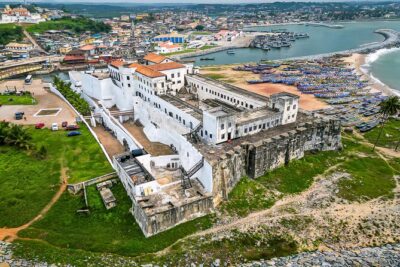
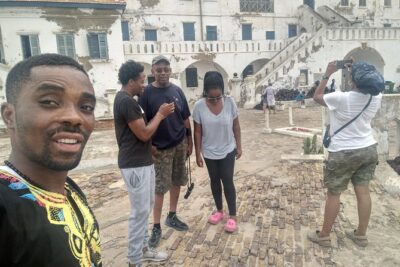
In Cape Coast, you visit Cape Coast Castle, a UNESCO World Heritage Site that includes the Door of No Return. The guided tour explains the castle’s role in the slave trade and makes the history tangible through its rooms and passageways.
You then check into your hotel, with the evening free. That open time is welcome after an emotionally demanding day. It also gives you room to rest rather than forcing another formal activity into the schedule.
Breakfast is included, but lunch and dinner are not. Plan on paying separately for most meals during the trip.
Day 6: Kakum’s forest canopy and Elmina Castle
Kakum National Park provides a sharp change of mood. You begin with a short walk on the forest floor, where you may see birds, butterflies, monkeys, and possibly other wildlife. The park is home to more than 40 mammal species, including the reclusive forest elephant, but wildlife sightings are never guaranteed.
The main attraction is the canopy walk: a 1,000-foot aerial walkway made up of seven bridges and viewing platforms. Some platforms rise more than 150 feet above the ground. If heights make you uneasy, this is the part of the itinerary to consider carefully. The schedule includes a brief forest walk and the canopy route, not a full-day wildlife safari.
In the afternoon, you visit Elmina Castle, built in 1482 and also recognized as a UNESCO World Heritage Site. Its age and coastal setting can make it seem almost picturesque at first, but the history is severe. The castle adds another layer to the previous day’s visit to Cape Coast and Assin Manso.
Seeing both Cape Coast Castle and Elmina Castle is valuable because each site gives you another view of the same broad history. It can also feel like a lot in a short period. I recommend taking notes, asking questions, and giving yourself quiet time afterward instead of trying to rush straight into shopping or nightlife.
Day 7: Abandze and the return to Accra
After breakfast, you check out and begin the road trip back to Accra. The route includes a brief stop at Abandze, described as the ancestral home of Louis Armstrong.
The stop is short, about two hours for the listed activity, so it is best viewed as a point of connection rather than a full museum visit. It adds an interesting link between Ghana and an important figure in American music.
You reach Accra in the late afternoon. If you still have energy, the itinerary suggests shopping along Oxford Street in Osu. Listed options include Global Mamas, Woodin, local stalls, colorful African clothing, beads, and accessories. Wild Gecko on Airport Road is another option for traditional crafts and artifacts.
The final evening is open for a farewell meal at a local restaurant outside the hotel and, for those who want it, Accra nightlife. These extras are not included, so budget separately. After several structured days, having a choice here is a good design feature.
Day 8: Flexible Accra time and airport transfer
The last day is intentionally light. With assistance from your driver and guide, you can choose sites in Accra or nearby areas that you have not yet seen.
This flexibility is useful if your arrival time prevented the University of Ghana visit or if you skipped a shopping stop. It is also a buffer for a trip that has covered a lot of ground. The airport transfer is included, and the experience ends back at Kotoka International Airport.
Because the day is listed as approximately two hours, you should not assume you have a full free day before an evening flight. Your departure time will determine how much sightseeing is practical.
Transport, group size, and daily comfort
The tour uses a private vehicle with air conditioning, and the advertised maximum is 10 people. That is a meaningful advantage on Ghana’s longer intercity drives. You are not waiting for a large coach group at every stop, and the guide can respond more easily to questions.
The route still involves substantial time on the road, particularly between Accra, Kumasi, and the Cape Coast area. Anyone who dislikes changing scenery from a vehicle window should think twice. The reward is that you reach places a short Accra stay cannot cover.
Breakfast is provided each day, but the dining plan is not fully covered. Food quality and choice can vary from stop to stop, so I would use the guide’s local advice and consider ordering individual meals rather than assuming every group dining arrangement will suit you.
Most people can participate, according to the tour information. The canopy walkway, forest paths, castle steps, and long drives are worth considering if you have mobility concerns, but no detailed accessibility description is provided.
Who should book this eight-day Ghana tour?
I would recommend it to first-time visitors who want a guided introduction to Ghana’s major historic and cultural regions. It suits people who value explanation, private transfers, hotel coordination, and a planned route more than independent wandering.
It is also a strong fit for a family-history or African diaspora trip. The Pan-African sites in Accra, Ashanti heritage in Kumasi, and slave-trade locations on the coast give the journey emotional and historical depth.
You may prefer a slower, custom-built trip if you want several nights in one place, long market visits, or more time at the beach. The schedule is full, and the two-hour activity blocks listed for several days should be read as highlights, not leisurely explorations.
The tour requires a visa and international flight, and it does not include insurance or gratuities. Confirmation is received when booking, mobile tickets are supported, and cancellation is free up to 24 hours before the start time. Within 24 hours, the payment is not refunded. Poor weather can also lead to a new date or a full refund.
Should you book it?
Book this tour if you want Ghana’s key sites connected into one carefully managed route, with strong guiding and a useful mix of city landmarks, royal history, textile crafts, forests, and coastal castles. The guides, especially George, Elvis, Emmanuel, and Naa, are a major part of the experience, and their ability to explain sensitive history can make a real difference.
Skip it if $5,060 feels high once flights, visa, meals, insurance, and gratuities are added, or if you want a slow trip with plenty of unplanned time. For a first visit, though, the route offers a serious amount of Ghana in eight days, and the private transport and included admissions make the price easier to justify.
FAQ
Where does the Ghana eight-day tour begin?
It begins at Kotoka International Airport in Accra, Ghana, where you meet the guide after immigration, baggage claim, and customs.
Where does the tour end?
The experience ends back at the meeting point, with a transfer to Kotoka International Airport for your onward flight.
What is included in the tour price?
The price includes arrival and departure assistance, round-trip airport and hotel transfers, hotel accommodation, private transportation, an experienced cultural guide, breakfast each day, admission to the listed sites, and help with the visa application.
Are international flights and visas included?
No. International flights and the visa itself are not included. Assistance with the visa application is included.
How large is the tour group?
The advertised maximum is 10 travelers.
Can I cancel for a full refund?
Yes, if you cancel at least 24 hours before the experience starts. Cancellations made within 24 hours are not refunded. If poor weather causes cancellation, you are offered a different date or a full refund.
Just added around Accra
- Accra City Tour★ 5.0 · 5 reviews
- Elmina & Cape Coast Castles Day Trip from Accra★ 5.0 · 5 reviews
- Cultural Village Tour: Traditional Naming Ceremony★ 5.0 · 5 reviews
- Accra Markets Tour★ 4.5 · 5 reviews
- Half-Day Accra City Tour Experience★ 5.0 · 7 reviews
- Historical & Cultural Tour of Ghana, 12 Days★ 5.0 · 7 reviews
- Introducing Ghana, 6 Days★ 5.0 · 7 reviews
- Accra: Tafi Kente Village, Monkey Sanctuary &Wli Waterfalls★ 4.5 · 4 reviews
Accra Tours, compared.
Experience the Beauty, History and the Culture Of Accra in a Day
Read our review →
Cape Coast, Elmina Castle & Kakum Park Day Tour
Read our review →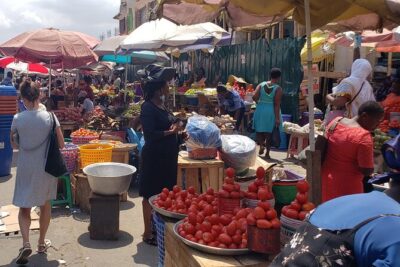
Boti Falls, Umbrella Rock, Aburi Gardens & Cocoa Farm Tour
Read our review →
Browse the lists this tour appears in